Azure Certifications serve to showcase and verify your expertise in specific cloud roles. However, with the wide range of Azure Certifications available, you might find it challenging to determine which one aligns best with your requirements. Therefore, we're here with another blog post that details everything you need to know about the Azure Certification Learning Path to help you select the most suitable certification for your needs.
The topics covered in this blog are:
Why Azure Certifications?
Azure Certification Levels
Azure Certification Path 2025
Microsoft Azure Certifications
Fundamentals
AZ-900: Microsoft Azure Fundamentals
AI-900: Microsoft AI Fundamentals
DP-900: Microsoft Azure Data Fundamentals
Associate
AZ-104: Microsoft Azure Administrator Associate
AZ-204: Microsoft Azure Developer Associate
DP-100: Microsoft Azure Data Scientist Associate
AI-102: Microsoft Certified: Azure AI Engineer Associate
DP-203: Microsoft Azure Data Engineer Associate
DP-300: Microsoft Azure Database Administrator Associate
PL-300: Microsoft Data Analyst Associate
AZ-500: Microsoft Azure Security Engineer Associate
Expert
Conclusion
Importance of Microsoft Azure certification
Azure is the leading cloud computing platform globally and dominates the market in this field. The need for cloud-based solutions continues to grow, prompting organizations of all sizes to transition their operations to the cloud to remain competitive. This shift is also increasing the demand for professionals skilled in cloud technologies. Microsoft offers certifications to individuals they consider the most qualified for specific job roles. These certifications are highly regarded, and many employers prefer candidates who include them on their resumes.
Why Should You Learn Microsoft Azure?
The global cloud computing market was valued at USD 602.31 billion in 2023 and is projected to expand at a CAGR of 21.2% from 2024 to 2030, underscoring the significant impact of cloud computing in recent years. Microsoft Azure remains a leading contender among top cloud service providers driving this growth.
With its top-tier tools and service offerings, it serves as an outstanding choice for businesses. Prominent firms such as eBay, Samsung, and BMW are some of the largest users of Microsoft Azure, showcasing its capabilities and offerings.
Microsoft Azure Certifications
Azure certifications are crucial for pursuing a career in the cloud computing sector. Microsoft currently offers 13 Azure certifications divided into three tiers: Fundamental, Associate, and Expert. These exams aim to validate your proficiency in the Azure cloud and are specifically designed to enhance your knowledge and skills relevant to today's job roles in the market.
Microsoft currently offers 13 Microsoft Azure certifications along with 14 exams. This update was made in collaboration with the community after assessing job requirements. Additionally, Microsoft has three foundational level certifications: Microsoft Certified: Azure AI Fundamentals Exam [AI-900], Azure Fundamentals (AZ-900), and Azure Data Fundamentals Exam [DP-900].

Microsoft has organized its certifications into four distinct levels, ranging from beginner to expert. All certifications offered by Microsoft fall within these Azure Certification path levels.
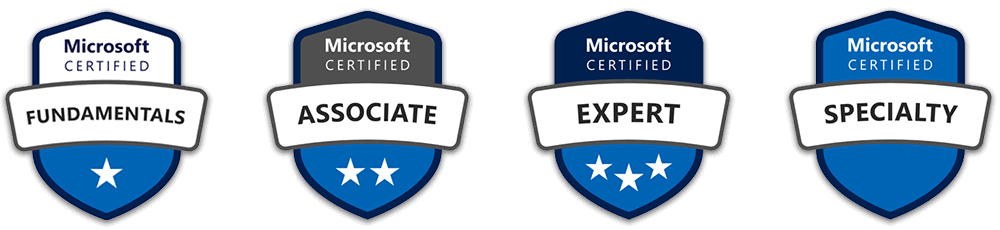
Fundamentals Certification – Fundamentals Certification is designed for newcomers who are beginning to explore cloud concepts. Additionally, individuals from non-technical backgrounds can also embark on their cloud journey with these certifications.
Associate Certification – If you already have experience with Azure, you’re set to add these certifications to your resume.
Expert Certification – Having prior experience, a strong understanding, and associate-level knowledge in Azure can lead you to obtain an expert certification.
Specialty Certification – These are currently available for a few roles like Azure for SAP Workloads and Azure IOT Developer Speciality.
Azure Certification Path in 2025

There are numerous Azure training, certification, and job roles available; however, we have highlighted the Microsoft Azure certification learning paths for some of the most sought-after job roles that many candidates aim for.
Microsoft Azure Certifications
I have provided a list of the most popular Azure Certifications, including a brief overview, exam details, and the domains covered, organized by their levels
Fundamentals
1) AZ-900: Microsoft Azure fundamentals certification
Azure Fundamentals provides a comprehensive introduction to cloud services. This certification encompasses essential topics such as networking, storage, computing, and security. It validates your understanding of cloud concepts, services, security measures, workloads, and pricing within Azure. This certification serves as the initial step in your Azure journey and is advantageous for individuals from both technical and non-technical fields. If you seek a roadmap for Microsoft Azure certification but have limited knowledge of cloud concepts, this certification is definitely suitable for you.
Certification Name: Microsoft Azure Fundamentals Certification.
Exam Code: AZ-900
Pre-requisites: There are no prerequisites for the Microsoft Azure Fundamental (AZ-900) exam, but you should be familiar with basic cloud services and the Azure platform.
Exam Cost: USD 99 (based on the location)
Exam Languages: English, French, Indonesian (Indonesia), Arabic (Saudi Arabia), Chinese (Traditional), Japanese, Chinese (Simplified), Korean, Spanish, German, Italian, Portuguese (Brazil), Russian.
Schedule Exam: Click here
Domains Covered in Azure – Fundamentals Exam [AZ-900] Exam
Describe Cloud Concepts(25-30%)
Describe Azure architecture and services(35-40%)
Describe Azure management and governance(30-35%)
2) AI-900: Microsoft AI Fundamentals
AI Fundamentals encompasses all essential knowledge related to Artificial Intelligence (AI) and Machine Learning (ML) concepts within Azure. While having a general understanding of a programming language can be helpful, it is not required, allowing individuals from both technical and non-technical backgrounds to participate in the AI-900 Azure certification pathway.
Certification Name: Microsoft Azure AI Fundamentals
Exam Code: AI-900
Pre-requisites: There are no prerequisites for this exam, but you should have a basic awareness of common ML and AI concepts and their relation with Azure.
Exam Cost: USD 99 (based on the location)
Exam Languages: English, Japanese, Chinese (Simplified), Korean, German, French, Spanish, Portuguese (Brazil), Russian, Indonesian (Indonesia), Arabic (Saudi Arabia), Chinese (Traditional), Italian
Schedule Exam: Click Here
Domains Covered in Azure AI – Fundamentals Exam [AI-900] Exam
Artificial Intelligence Workloads and Considerations(15-20%)
Fundamental Principles of Machine Learning on Azure(20-25%)
Features of Computer Vision Workloads on Azure(15-20%)
Features of Natural Language Processing (NLP) workloads on Azure(15-20%)
Describe features of generative AI workloads on Azure(15-20%)
3) DP-900: Microsoft Azure Data Fundamentals
Azure Data Fundamentals encompasses essential knowledge of fundamental data concepts. This certification addresses the basics of data concepts and the use of Microsoft data services. It demonstrates your understanding of cloud concepts, services, security, workloads, and pricing in Azure. This certification serves as the initial step into the Azure ecosystem and is advantageous for individuals from both technical and non-technical backgrounds. If you seek an Azure certification path but have limited knowledge of cloud concepts, this certification is undoubtedly the right choice for you.
Certification Name: Microsoft Certified: Azure Data Fundamentals
Exam Code: DP-900
Pre-requisites: There are no prerequisites for this exam.
Exam Cost: USD 99 (based on the location)
Exam Languages: English, Japanese, Chinese (Simplified), Korean, French, German, Spanish, Portuguese (Brazil), Russian, Indonesian (Indonesia), Arabic (Saudi Arabia), Chinese (Traditional), Italian
Schedule Exam: Click Here
Domains Covered in Azure Data – Fundamentals Exam [DP-900] Exam
Describe core data concepts(25-30%)
Identify considerations for relational data on Azure(20-25%)
Describe considerations for working with non-relational data on Azure(15-20%)
Describe an analytics workload on Azure(25-30%)
Associate- Azure Certifications
4) AZ-104: Microsoft Azure Administrator Associate
The Azure Administrator is responsible for implementing and managing storage, computing, identity, governance, and virtual networks within the cloud. They also oversee and monitor cloud resources. Candidates should have experience with Azure Portal, PowerShell, Azure CLI, and ARM Templates.
Certification Name: Microsoft Azure Administrator
Exam Code: AZ-104
Pre-requisites: There are no prerequisites for taking this exam. But it would be better if you go for AZ-900 (optional) first. The candidate should have at least six months of hands-on experience administering Azure.
Exam Cost: USD 165 (based on the location)
Exam Languages: English, French, German, Spanish, Chinese (Simplified), Korean, Japanese
Schedule Exam: Click Here
Domains Covered in Azure Administrator – Associate Exam [AZ-104] Exam
Manage Azure identities and governance(20-25%)
Implement and manage storage(15-20%)
Deploy and manage Azure compute resources(20-25%)
Configure and manage virtual networking(15-20%)
Monitor and back up Azure resources(10-15%)
5) AZ-204: Microsoft Azure Developer Associate
An Azure Developer is responsible for the design, construction, testing, and maintenance of cloud applications and services. In this position, Microsoft expects you to be proficient in programming languages supported by Azure, as well as having experience with Azure PowerShell, Azure SDKs, Azure CLI, data storage solutions, data connections, APIs, and app authentication and authorization. The developer engages in several phases as outlined below.
Cloud development requirements, definition, and design.
Development, deployment, and maintenance.
Performance tuning and monitoring.
Certification Name: Microsoft Certified Azure Developer Associate
Exam Code: AZ-204
Pre-requisites: There are no prerequisites for taking this exam. But it would be better if you go for AZ-900 (optional) first. The candidate should have 1-2 years of professional development, Microsoft Azure experience, and programming expertise in at least one high-level language supported by Azure.
Exam Cost: USD165 (based on the location)
Exam Language: English, Japanese, Chinese (Simplified), Korean.
Schedule Exam: Click Here
Domains Covered in Azure Developer – Associate Exam [AZ-204] Exam
Develop Azure compute solutions(25-30%)
Develop for Azure storage(15-20%)
Implement Azure security(15-20%)
Monitor, troubleshoot, and optimize Azure solutions.(10-15%)
Connect to and consume Azure services and third-party services(20-25%)
6) DP-100: Microsoft Azure Data Scientist Associate
Data Scientists focus on data science and execute machine learning tasks on Azure. An Azure Data Scientist should possess expertise in data science and hands-on experience with Azure Machine Learning and Azure Databricks. The primary responsibilities of this role involve managing, optimizing, and deploying machine learning models into production.
Certification Name: Microsoft Certified: Azure Data Scientist Associate.
Exam Code: DP-100
Pre-requisites: There are no such prerequisites for taking this certification. But it would be better if you go for DP-900 (optional)/ AI-900 (optional) first. The candidate should have knowledge and experience in data science and using Azure Machine Learning and Azure Databricks.
Exam Cost: USD 165 (based on the location)
Exam Language: English, Japanese, Chinese (Simplified), Korean
Schedule Exam: Click Here
Domains Covered in Azure Data Scientist – Associate Exam [DP-100] Exam
Design and prepare a machine-learning solution(20-25%)
Explore data, and run experiments(20-25%)
Train and deploy models(25-30%)
Optimize language models for AI applications(25-30%)
7) AI-102: Microsoft Certified: Azure AI Engineer Associate
The AI-102 exam, named "Designing and Implementing an Azure AI Solution," evaluates your skills in designing and implementing AI solutions utilizing Azure Cognitive Services, Azure Machine Learning, and other related Azure services.

Certification Name: Microsoft Certified: Azure AI Engineer Associate
Exam Code: AI-102
Prerequisites: There are no mandatory prerequisites. However, knowledge of AI-900 (optional) or experience in AI and Azure Cognitive Services is recommended.
Exam Cost: USD 165 (based on location)
Exam Languages: English, Japanese, Chinese (Simplified), Korean
Schedule Exam: Click Here
Domains Covered in Microsoft Certified: Azure AI Engineer Associate AI-102 Exam
Plan and manage an Azure AI solution(25-30%)
Implement image and video processing solutions(15-20%)
Implement Computer Vision Solutions(15-20%)
Implement Natural Language Processing Solutions(25-30%)
Implement knowledge-mining solutions(5-10%)
Implement conversational AI solutions(15-20%)
8) DP-203: Microsoft Azure Data Engineer Associate
Data engineering involves the integration, transformation, and consolidation of data from multiple systems to create analytics solutions. A data engineer is responsible for designing, implementing, optimizing, and monitoring data platforms to fulfill the requirements of data pipelines. Additionally, they assist stakeholders in comprehending the data through exploration while ensuring secure and compliant data processing pipelines using various tools and techniques.
Certification Name: Data Engineering on Microsoft Azure
Exam Code: DP-203
Pre-requisites: There are no prerequisites for taking this exam. But it would be better if you go for DP-900 (optional) first. The Candidates must have a good knowledge of data processing languages such as SQL, Python, and Scala.
Exam Cost: USD 165 (based on the location)
Exam Languages: English, Chinese (Simplified), French, Spanish, Portuguese (Brazil), Japanese, Korean, German, Arabic (Saudi Arabia), Russian, Chinese (Traditional), Italian, Indonesian (Indonesia)
Schedule Exam: Click Here
Domains Covered in Data Engineering on Microsoft Azure [DP-203:] Exam
Design and implement data storage(15-20%)
Develop data processing(40-45%)
Secure, monitor, and optimize data storage and data processing(30-35%).
9) DP-300: Azure Database Administrator Associate
An Azure Database Administrator is responsible for implementing and managing platform solutions utilizing Microsoft SQL Server and Microsoft Azure Data Services. Daily tasks involve using various methods and tools for operations, including managing T-SQL.
Certification Name: Administering Relational Databases on Microsoft Azure
Exam Code: DP-300
Pre-requisites: There are no prerequisites for taking this exam. But it would be better if you go for DP-900 (optional) first.
Exam Cost: USD 165 (based on the location)
Languages: English, Chinese (Simplified), Japanese, Korean, French, German, Portuguese (Brazil), Italian, Chinese (Traditional), Spanish
Schedule Exam: Click Here
Domains Covered in Administering Relational Databases on Microsoft Azure [DP-300] Exam
Plan and implement data platform resources(20-25%)
Implement a secure environment(15-20%)
Monitor, configure, and optimize database resources(20-25%)
Configure and manage automation of tasks(15-20%)
Plan and configure a high availability and disaster recovery (HA/DR) environment(20-25%)
10) PL-300: Microsoft Power BI Data Analyst Associate
A Data Analyst is involved in loading, transforming, and analyzing data. Their primary objective is to derive meaningful insights from vast amounts of raw data. A Data Analyst's role includes examining data and producing clear and understandable visual representations. This involves creating data models, graphs, and charts while utilizing DAX expressions and machine learning models. This Azure certification path is designed for anyone interested in data analysis and learning how to carry out data operations for their business or organization.
Certification Name: Power BI Data Analyst Associate
Exam Code: PL-300
Pre-requisites: There are no prerequisites for taking this exam. But it would be better if you go for DP-900 (optional) first. The Candidates must have a fundamental understanding of data repositories and data processing (on-premises and in the cloud).
Exam Cost: USD 165 (based on the location)
Exam Languages: English, Japanese, Chinese (Simplified), Korean, German, French, Spanish, Portuguese (Brazil), Arabic (Saudi Arabia), Russian, Chinese (Traditional), Italian, Indonesian (Indonesia)
Schedule Exam: Click Here
Microsoft Power BI Data Analyst [PL-300] Exam
Prepare the data (25-30%)
Model the data(25-30%)
Visualize and analyze the data(25-30%)
Manage and secure Power BI(15-20%)
11) AZ-500: Microsoft Azure Security Engineer Associat
An Azure Security Engineer is responsible for managing identity and access, implementing security measures and threat protection, and safeguarding data, applications, and networks in the cloud. This role requires knowledge of networking, virtualization, and cloud N-tier architecture to recommend different security solutions that address vulnerabilities or threats.
Certification Name: Microsoft Azure Security Technologies
Exam Code: AZ-500
Exam Cost: USD 165 (based on the location)
Pre-requisites: Microsoft doesn’t have any mandatory prerequisites for the AZ-500 exam. It is advised that you take the AZ-900 (optional) exam if you are just starting your career in the cloud.
Exam Languages: English, Japanese, Chinese (Simplified), Korean
Schedule Exam: Click Here
Domains Covered in Azure Security Engineer – Associate Exam [AZ-500] Exam
Manage identity and access(25-30%)
Secure networking(20-25%)
Secure computing, storage, and databases(20-25%)
Manage security operations(25-30)
Expert
12) Microsoft Certified Solutions Architect [AZ-305]
This program focuses on designing and implementing solutions that operate on Microsoft Azure, covering areas such as compute, networking, storage, and security.
It aims to guide stakeholders and convert business needs into secure, scalable, and dependable solutions. Additionally, candidates must possess advanced skills in Azure administration as well as experience in Azure development and DevOps practices.
Certification Name: Microsoft Azure Architect Technologies
Exam Code: AZ-305
Pre-requisite: You must clear Azure Administrator ( Az-104 Exam) certification.
Exam Cost: USD 165 (based on the location)
Exam Languages: English, Japanese, Chinese (Simplified), Korean
Schedule Exam: Click Here
Domains Covered in Microsoft Certified Solutions Architect – Expert Exams [AZ-303] Exam
Design identity, governance, and monitoring solutions(25-30%)
Design data storage solutions(20-25%)
Design business continuity solutions(15-20%)
Design infrastructure solutions(30-35%)
13) AZ-400: Microsoft DevOps Engineer Expert
The DevOps Engineer is responsible for developing and executing strategies related to collaboration, coding, infrastructure, source control, security, compliance, continuous integration, testing, delivery, monitoring, and feedback. They establish software automation pipelines to facilitate a comprehensive development and deployment lifecycle in the cloud. Candidates seeking this certification should possess knowledge of Azure administration and development and must have passed one exam, either the AZ-104 or AZ-204 exam.
Certification Name: Microsoft Azure DevOps Engineer Expert
Exam Code: AZ-400
Pre-requisite: You must clear either Azure Administrator (AZ-104) or Azure Developer (Az-204) Certification.
Exam Cost: USD 165 (based on the location)
Exam Languages: English, Japanese, Chinese (Simplified), Korean, German, French, Spanish, Portuguese (Brazil), Arabic (Saudi Arabia), Russian, Chinese (Traditional), Italian, Indonesian (Indonesia)
Schedule Exam: Click Here
Domains Covered in Azure DevOps Engineer – Expert Exam [AZ-400]Exam
Design and implement processes and communications(10-15%)
Design and implement a source control strategy(10-15%)
Design and implement build and release pipelines(50-55%)
Develop a security and compliance plan(10-15%)Implement an instrumentation strategy(5-10%)
Conclusion
Cloud technology is expanding quickly, and to meet future challenges, every aspiring cloud professional must equip themselves accordingly. Microsoft Azure offers a range of cloud certifications tailored for different roles. The Microsoft Azure certifications mentioned here are among the most sought-after by candidates


